


Business
The Key Gains: Inside Nigeria–UK £746m Port Upgrade Deal
aimed at overhauling infrastructure at the country’s busiest ports


President Bola Ahmed Tinubu has witnessed the signing of a £746 million agreement between Nigeria and the United Kingdom aimed at overhauling infrastructure at the country’s busiest ports, in a move authorities say could significantly cut logistics costs, boost export capacity and reposition Nigeria within the global maritime economy.
The agreement, backed by UK Export Finance, provides a £746 million loan guarantee covering a substantial portion of the modernisation of Apapa and Tin Can Island ports. Officials say the financing structure is designed to ease immediate fiscal pressure while enabling large-scale upgrades tied to international delivery standards.
Under the deal, £236 million is earmarked for UK supplier contracts, with British firms expected to play key roles across engineering, logistics and systems automation.
The arrangement also includes the supply of 120,000 tonnes of British steel, which will be deployed in reinforcing port infrastructure and expanding terminal capacity.
Government sources say the most immediate gains are expected in port efficiency. Cargo dwell time, currently averaging up to 15 days, is projected to drop to between one and five days as operations transition from manual processes to automated systems.
This, analysts note, could ease congestion and improve turnaround time for vessels and cargo.
The agreement also targets a reduction in logistics costs, with estimates suggesting a drop from about $2,000 per container to between $1,000 and $1,500.
If achieved, the reduction is expected to improve Nigeria’s competitiveness, particularly for exporters facing high transaction costs.
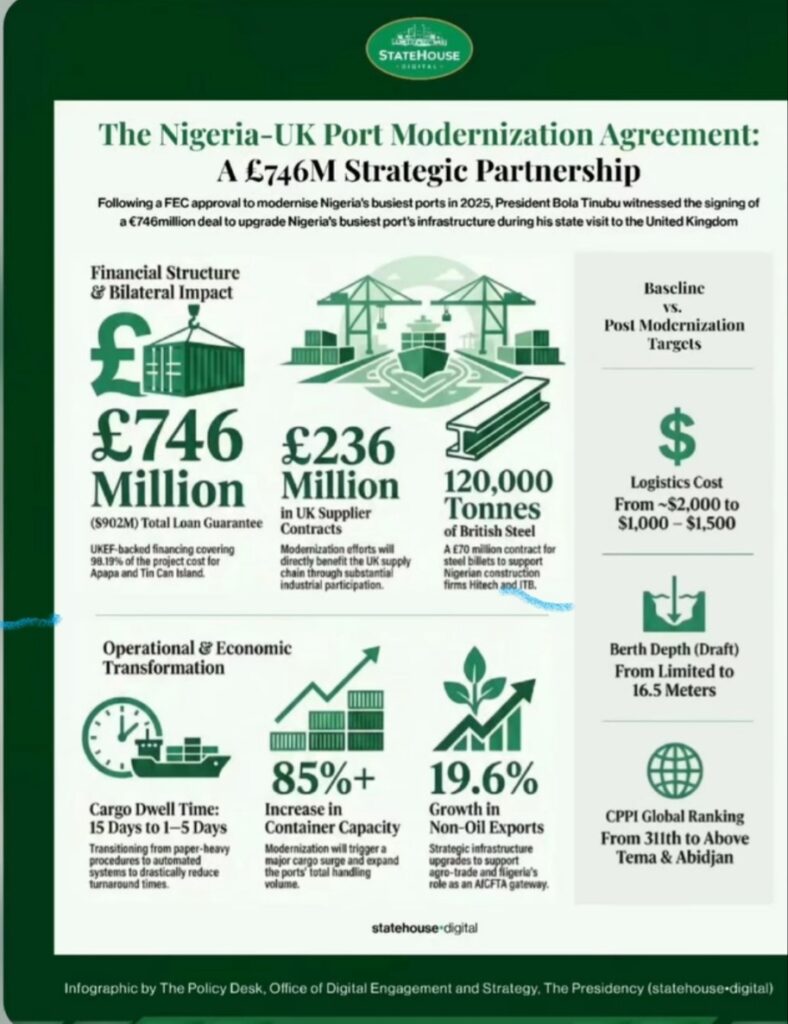
Capacity expansion forms a central pillar of the upgrade. Container handling capacity is projected to rise by more than 85 percent, while non-oil exports are expected to grow by 19.6 percent, driven by improved infrastructure and more efficient cargo movement.
In addition, berth depth at the ports is set to increase to 16.5 metres, allowing larger vessels to dock directly and reducing reliance on transshipment through regional hubs.
The upgrade is also expected to improve Nigeria’s standing on the Container Port Performance Index, where it currently trails ports such as Tema in Ghana and Abidjan in Côte d’Ivoire.
Officials say the project aligns with the administration’s broader economic agenda to drive trade, support industrial growth and strengthen Nigeria’s role as a gateway for commerce in West Africa.
While the projections signal a potentially transformative shift, attention is now turning to execution, with stakeholders watching closely to see whether the targets on cost, capacity and efficiency can be delivered within the proposed timelines.
