

Politics
Tinubu Declares Total War On Bandits, Waste And Poverty In Bold 2026 Budget
outlining a budget he said would move Nigeria “from survival to growth.”

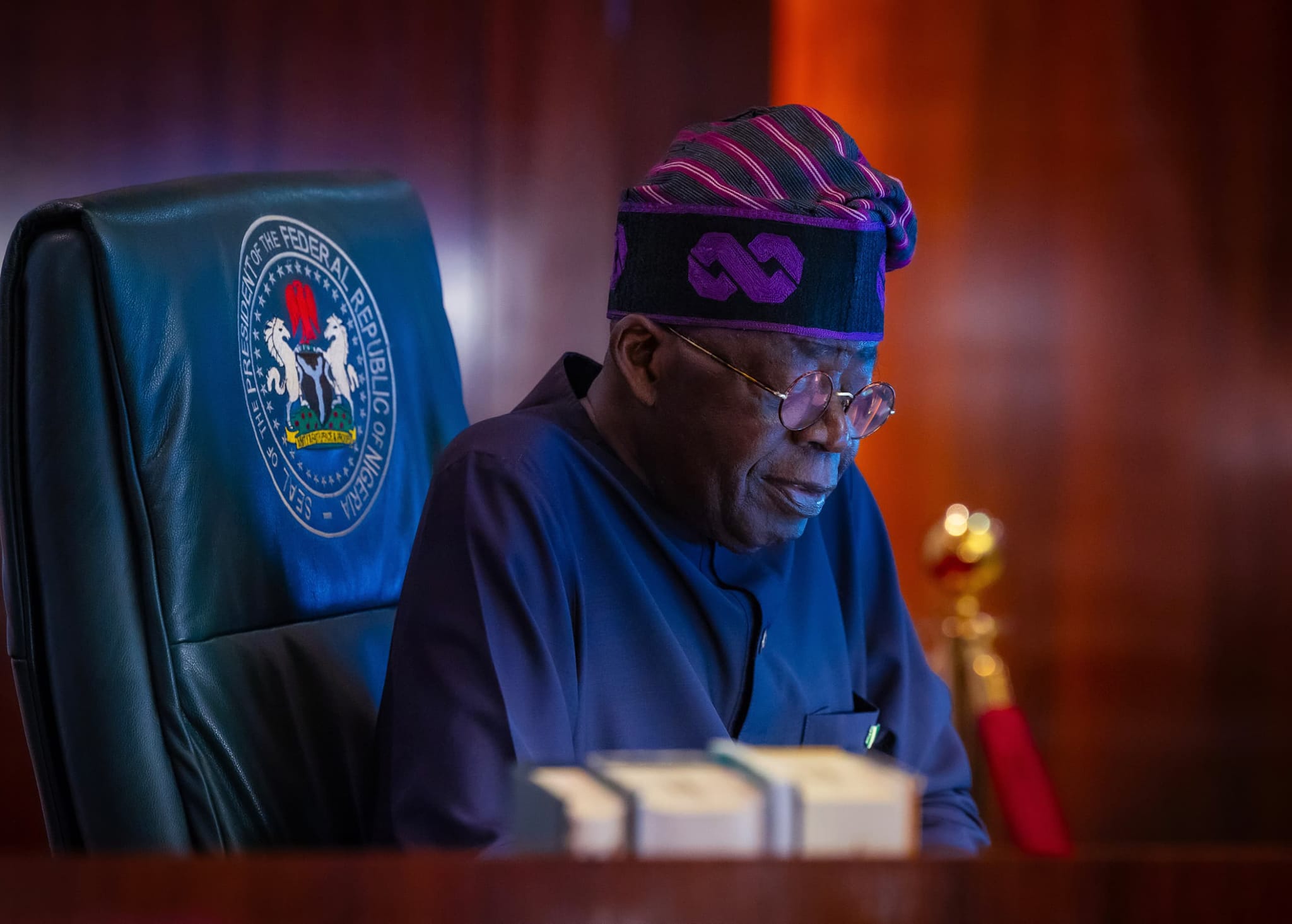
President Bola Ahmed Tinubu on Friday, December 19, 2025, declared intensified war on banditry, fiscal waste and poverty as he presented the 2026 Appropriation Bill to a joint session of the national assembly, outlining a budget he said would move Nigeria “from survival to growth.”
The President said the 2026 budget, titled “Budget of Consolidation, Renewed Resilience and Shared Prosperity”, represents “a defining moment in our national journey of reform and transformation,” coming after what he acknowledged as a difficult but necessary period of economic adjustment.
“Though necessary, the reforms have not been painless,” the president said, adding that families and businesses had faced pressure..
“Yet, I am here today to assure Nigerians that their sacrifices are not in vain. The path of reform is seldom smooth, but it is the surest route to lasting stability and shared prosperity,” the nation’s first citizen stated.
According to Tinubu, the reforms undertaken over the last two and a half years are already yielding results. The renewed hope personified cited improved economic growth, easing inflation, rising external reserves and renewed investor confidence, noting that the economy grew by 3.98 percent in the third quarter of 2025, compared with 3.86 percent in the same period of 2024.
He said headline inflation moderated for eight consecutive months, declining to 14.45 percent in November 2025 from 24.23 percent in March.
“With stabilising food and energy prices, tighter monetary conditions, and improving supply responses, we expect the deflationary trend to persist,” he added.
The president also said oil production has improved due to enhanced security and sector reforms, while non-oil revenues have expanded significantly through better tax administration.
He further revealed that Nigeria’s external reserves rose to about 47 billion dollars, a seven-year high, providing over ten months of import cover. “These outcomes are not accidental or lucky. They are the consequence of our difficult policy choices,” Tinubu said.
On budget performance, the president said implementation in 2025 faced transition pressures and competing execution demands. As of the third quarter, revenue stood at N18.6 trillion, representing 61 percent of the target, while expenditure reached N24.66 trillion, about 60 percent of projections. He said only N3.10 trillion, about 17.7 percent of the 2025 capital budget, had been released by Q3 due to the prioritisation of outstanding 2024 capital projects.
Tinubu assured lawmakers that 2026 would mark a shift to stronger fiscal discipline. “I have issued directives to ensure that the 2026 Budget is implemented strictly in line with the appropriated details and timelines,” he said.
He observed that improved revenue performance is expected from new national tax laws and ongoing oil and gas reforms, alongside aggressive digitisation of government revenue collection. According to him, the aim is to “seal leakages, ensure verifiable compliance and guarantee prompt remittances,” warning that Nigeria “can no longer afford inefficiencies or underperformance in strategic agencies.”
The 2026 budget projects total revenue of N34.33 trillion and total expenditure of N58.18 trillion, including N15.52 trillion for debt servicing. Recurrent non-debt expenditure is estimated at N15.25 trillion, while capital expenditure is projected at N26.08 trillion. The budget deficit of N23.85 trillion represents 4.28 percent of GDP.
Tinubu said the projections were based on a conservative oil price benchmark of 64.85 dollars per barrel, oil production of 1.84 million barrels per day, and an average exchange rate of N1,400 to the dollar.
“We will continue to reduce waste, strengthen controls, and ensure that every naira borrowed or spent delivers measurable public value,” Nigeria’s helmsman stressed.
Security featured prominently, with N5.41 trillion allocated to defence and security. Tinubu said his administration is resetting the national security architecture and rolling out a new counterterrorism doctrine anchored on unified command, intelligence and community stability.
“Under this new architecture, any armed group or gun-wielding non-state actor operating outside state authority will be regarded as terrorists,” he asserted, vowing that bandits, militias, kidnappers, violent cults and their sponsors would be decisively confronted.
“We will show no mercy to those who commit or support acts of terrorism and violent crimes,” he insisted.
On human capital development, the president said N3.52 trillion was allocated to education and N2.48 trillion to health. He noted that over 788,000 students have benefitted from the Nigerian Education Loan Fund, while recent engagements with the United States government unlocked over 500 million dollars for health interventions across the country. “These resources will be deployed transparently and effectively,” he assured.
Infrastructure spending was pegged at N3.56 trillion, with Tinubu stressing the link between security, education, health and productivity. He said agriculture remains a national priority, with focus on mechanisation, irrigation, storage and agro-value chains to improve food security and incomes.
According to the nation’s leader, the Bank of Agriculture plans to support the cultivation of one million hectares in 2026, create hundreds of thousands of jobs and boost exports.
The president also highlighted procurement reforms and the Nigeria First policy, which prioritises local goods and companies in government spending. He said the measures have already delivered cost savings, reduced contract processing times and strengthened enforcement against erring contractors and officials.
“The most significant budget is not the one we announce. It is the one we deliver,” Tinubu said, committing his administration to better revenue mobilisation, disciplined spending and stronger accountability.
He urged the national assembly to partner with the executive in steering the country towards what he described as “a more secure, more competitive, more equitable, and more hopeful Nigeria.”