


Entertainment
Complete Story Of Kwam1’s Near Death Episode With Value Jet
an episode that has since triggered a nationwide conversation


On the morning of August 5, 2025, Fuji icon, King Wasiu Ayinde Marshal (KWAM 1), also known as K1 De Ultimate, was at the centre of a dramatic safety incident at Nnamdi Azikiwe International Airport, Abuja—an episode that has since triggered a nationwide conversation about aviation protocol, celebrity privilege, and public safety.
According to multiple accounts, the musician was scheduled to travel on a ValueJet flight from Abuja to Lagos when a disagreement ensued between him and aviation security (AVSEC) officials over a flask of liquid in his possession.
Sources allege that the container held alcohol, which is not permitted in hand luggage under both the National Civil Aviation Security Programme and international aviation safety regulations, including ICAO Annex 17.
Airport officers advised the Fuji star to either discard the contents or have it properly documented for medical or official use. He reportedly refused.
The confrontation took a volatile turn when K1 allegedly poured the contents of the flask on one of the security officers, a gesture interpreted as both defiant and provocative.
Despite warnings from ValueJet crew and airport authorities, the musician refused to board without his item. After being removed from the passenger manifest, the incident appeared to have reached its end—until the unthinkable happened.
Eyewitness videos later circulated showing K1 emerging on the tarmac and standing directly in front of the aircraft’s nosewheel as it prepared for taxiing. The footage, which went viral within hours, captured a narrow escape: the aircraft’s nose nearly struck the artist before he ducked out of harm’s way.
The images were disturbing, not just for their physical danger but for what they suggested about gaps in airport security enforcement.
The Federal Airports Authority immediately launched an investigation. FAAN officials, speaking off the record, confirmed that K1 had violated restricted area regulations and jeopardised the safety of an active runway environment.
The Nigeria Civil Aviation Authority (NCAA) followed up by suspending the aircraft’s captain and first officer—Captain Oluranti Ogoyi and First Officer Ivan Oloba—citing procedural failures, particularly the crew’s decision to begin taxiing while an unauthorised person was still within danger range. The agency described the situation as a near-catastrophic security breach.
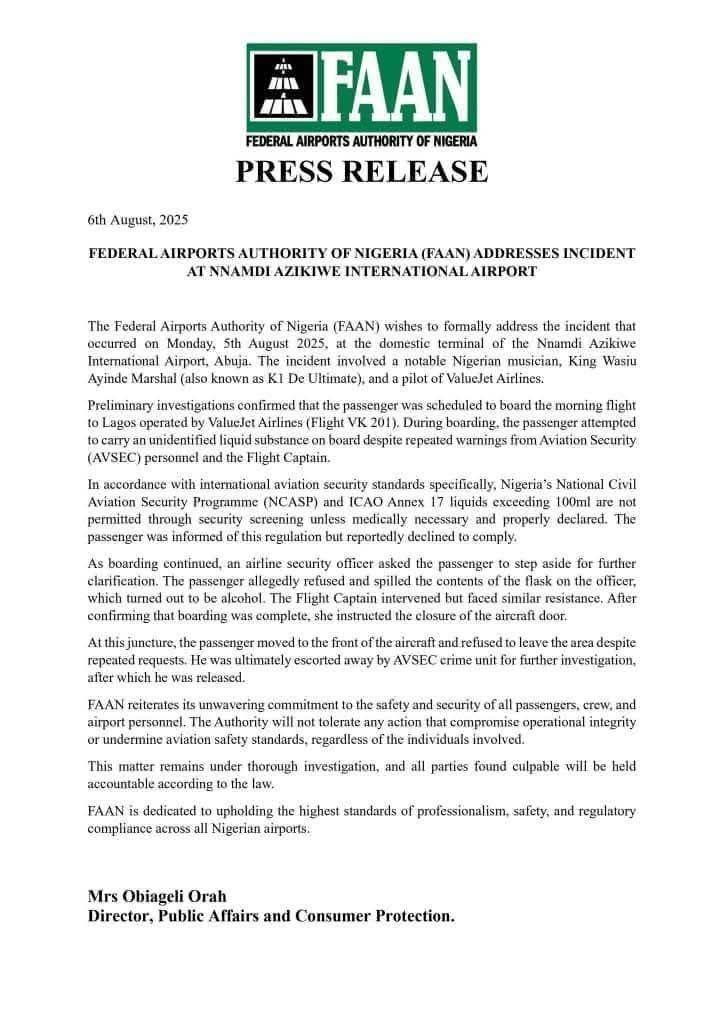
ValueJet, in its own statement, confirmed it had grounded the flight crew pending further investigation and was cooperating fully with regulatory bodies.
Internally, the airline began a safety audit to understand how the aircraft moved despite the presence of a pedestrian on the tarmac.
In response, the musician’s camp strongly denied several of the claims that had circulated in the press and on social media. K1’s media aide, Kunle Rasheed, issued a statement describing the reports as sensationalised and inaccurate. He maintained that the flask contained only drinking water provided at the VIP lounge and not alcohol. He further claimed that at no point did the musician act in a disorderly or threatening manner.
The aide alleged that, contrary to the image of conflict and confrontation, airport and airline officials actually apologised to the musician and even offered to arrange a private jet for his travel to Lagos.
This account, however, did little to stem public concern.
On social media and among aviation watchers, reactions were mixed—ranging from outrage at the musician’s alleged disregard for safety procedures to shock at how close Nigeria came to a tragedy involving a celebrity on a public runway.
Some observers questioned whether a less prominent individual would have been treated with similar leniency. Others noted that the incident underscored broader vulnerabilities in Nigeria’s aviation system, particularly in enforcing secure zones and regulating the behaviour of VIP passengers.
As investigations continue, the affair stands as a stark cautionary tale. A moment’s insistence on personal preference nearly resulted in irreversible loss—not only to the life of one of Nigeria’s most celebrated musicians, but to the safety record of the nation’s aviation system.
The incident has forced regulators, airline operators, and the public to re-examine where the line must be drawn between access and accountability, status and security.