

Society
Rare, Enjoys Squash & Reading – All You Should Know About Distinguished & Talk-Of-The Town Gen Uba
one of the country’s most versatile senior military officers

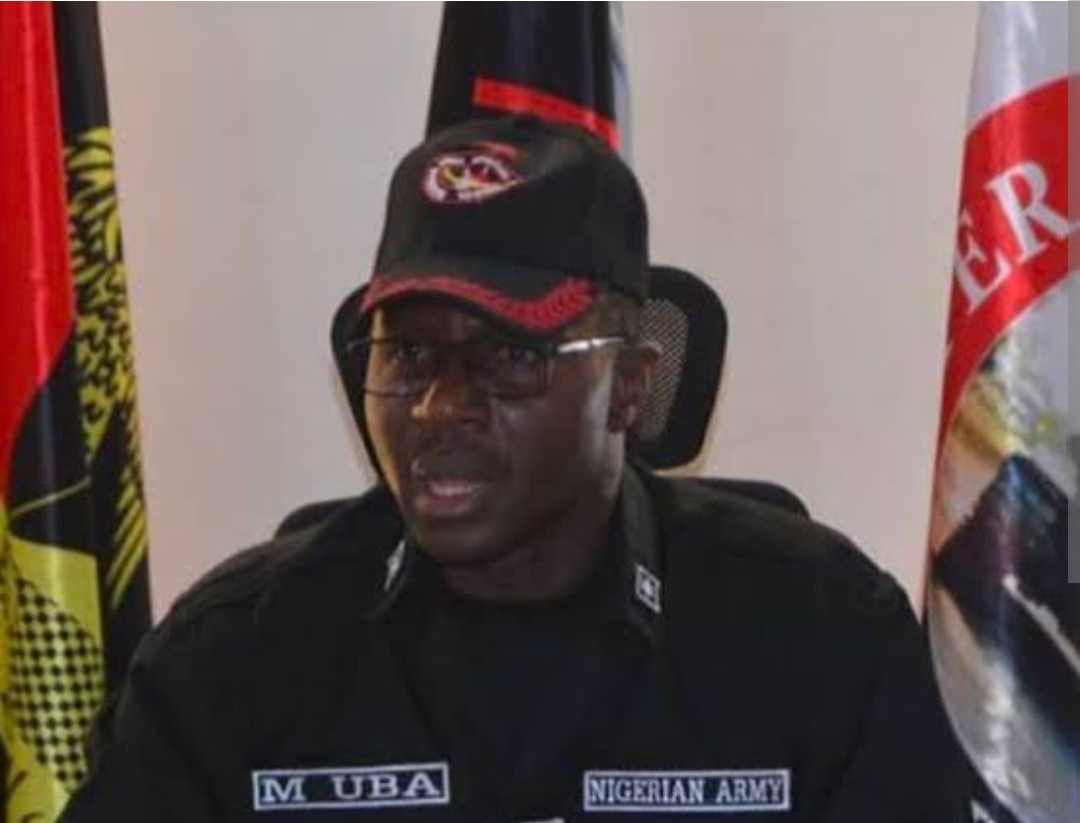
Until recently, Brigadier General Mohammed Uba stood out in the Nigerian military as one of the rare officers whose career blended battlefield command with articulate, disciplined public engagement.
His journey from a young communication graduate in Kano to one of the country’s most versatile senior military officers is a story of steady rise, intellectual curiosity and frontline grit.
Born on July 1, 1968, in Tudun Wada, Nasarawa Local Government Area of Kano State, Uba was not the typical combat-only officer.
He earned a Bachelor’s degree in Mass Communication from Bayero University, Kano, before furthering his education with a postgraduate diploma in public administration from the Ghana Institute of Management and Public Administration, and a Master’s degree in Strategic and Development Studies from the Bangladesh University of Professionals.
His academic record alone set him apart, but it was his ability to apply that knowledge in uniform that defined much of his career.
He joined the Nigerian Army through the Short Service Combatant Course 30 of the Nigerian Defence Academy and was commissioned as a Second Lieutenant on March 13, 1993.
His early years in service were shaped by his deployment to the Directorate of Army Public Relations, an unusual starting point that made full use of his communication background. But Uba was not destined to remain behind a desk. He later moved to the Infantry Corps, beginning the progression that would turn him into an operational commander trusted with some of the country’s toughest assignments.
The officer’s training record was as broad as his postings. He attended the Senior Staff Course at the Ghana Armed Forces Command and Staff College and completed the National Defence Course at the National Defence College in Bangladesh.
His colleagues often described him as a meticulous instructor, a reputation strengthened by his posting to the Armed Forces Command and Staff College, Jaji, where he served as Chief Instructor and directing staff.
He later led the Defence Headquarters Training Team at the Nigeria Customs Command and Staff College, Gwagwalada, helping to develop senior-level competencies for a different uniformed service.
On the field, Uba’s leadership at the 401 Special Forces Brigade in Borno left an imprint on counter-insurgency operations. His command was credited with restricting the freedom of action of insurgents while maintaining a respectful relationship with surrounding communities.
The dual ability to fight and to build trust became a constant feature of his work. Before returning to frontline command, he also held strategic appointments including Deputy Director of Peacekeeping Operations, Director of Personnel Services at Army Headquarters, and Director of the Department of Joint Studies at AFCSC, Jaji.
His most recent appointment as Director of Defence Information reflected a natural progression. He arrived with a clear philosophy: unity of purpose, transparency, and a commitment to modernising the military’s communication architecture.
In this role, reports described him as courteous but firm, and unmistakably professional — the sort of officer who understood that narratives shape national confidence just as much as battlefield outcomes.
Yet it was not any of these roles that made him a national topic in recent days. It was the controversy surrounding his final mission — an ambush on the Damboa–Biu axis — that drew intense public attention.

What should have been a routine operational movement turned into one of the most disputed military episodes in recent years. Insurgent fighters claimed they captured him alive, releasing images and statements to back their narrative.
The Army strongly countered the claims, insisting he was never abducted and had instead led his men back to base after the attack.
A video was circulated in which he declared he was safe, but subsequent reports and alleged photographs suggested otherwise.
The conflicting accounts triggered widespread debate, questions about battlefield communication, and concerns over the accuracy of official briefings in fast-moving conflict situations.
The lack of immediate independent confirmation only deepened the controversy, turning his fate into a matter of national conversation and speculation.
Decorated with the Grand Service Star, Distinguished Service Star, Field Command Medal, Passed Staff Course (++) and multiple commendation awards, Uba also belonged to several professional bodies.
He was a Fellow of the Nigerian Institute of Public Relations, a member of the Nigerian Institute of Management, the Nigerian Army Resource Centre, and the Nigerian Society of International Affairs. These affiliations reflected a man who saw soldiering not just as force projection but as a disciplined, evolving profession.
Away from command decisions and military paperwork, Uba was known to be a private, grounded family man. His leisure interests were simple — squash and reading — two habits that colleagues say helped him relax and reflect even in the intense pressure of service. Those close to him often spoke of his calm manner and the depth of his thinking, qualities that made him respected across the hierarchy.
In a military environment where straight-line career paths are common, Brigadier General Mohammed Uba was one of the few who combined intellectual depth, instructional competence, and operational leadership in equal measure.
His career reflects a rare blend of force, thought, discipline and humanity — and in the wake of the controversies surrounding his final mission, his name has become a symbol of both service and the complexities of Nigeria’s ongoing security challenges.