

Politics
2027: “Don’t Take Nigeria Backwards!” — Tinubu To Opposition, Promises Stronger Economy After Clinching APC Ticket
declaring that Nigeria must not “give in to complacency”

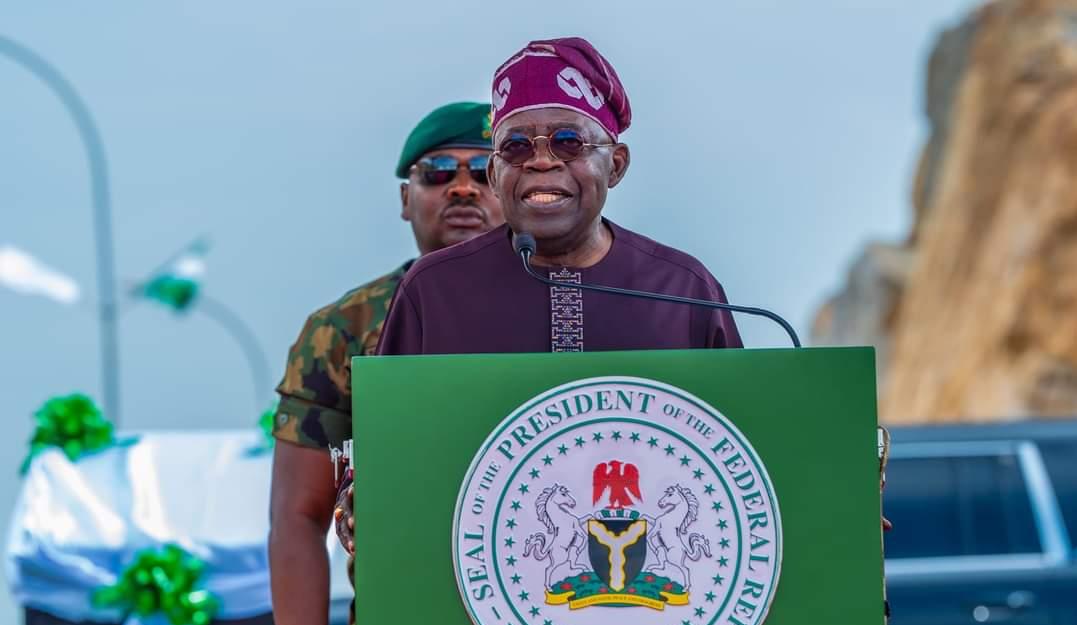
President Bola Ahmed Tinubu on Sunday, May 24, 2026, formally accepted his nomination as the presidential candidate of the All Progressives Congress, APC, for the 2027 election, declaring that Nigeria must not “give in to complacency” by allowing politicians without “clear alternative vision” to derail the reforms of his administration.
Speaking at the Bola Ahmed Tinubu International Conference Centre, Abuja, the President said the 2027 election would be a defining moment for the country’s democratic and economic future, insisting that the reforms initiated under his administration were already yielding results despite prevailing hardship and global economic pressures.
Addressing party leaders, governors, lawmakers and supporters, Tinubu said: “Today, our task is to affirm that continuity is essential—to consolidate reform, secure progress, and strengthen the foundation of a modern Nigeria.”
The President, who reflected on his emergence as APC candidate in 2022 and eventual victory at the polls, said he was returning before party members “humbled by your enduring support, encouraged by your continued confidence, and imbued with renewed passion for the tasks ahead.”
“I accept, with humility and profound gratitude, the nomination of our great party, the All Progressives Congress, to stand again as its Presidential candidate in the 2027 election,” he declared.
The President used the occasion to defend his administration’s economic reforms, insisting that difficult decisions taken since 2023 were laying the foundation for long-term growth and stability.
“We moved away from wasteful fuel subsidies, unstable exchange rates, and weak infrastructure. Today, we are witnessing a turnaround: the naira is strengthening, foreign reserves are rising, and our economic outlook is positive despite the inflationary disruption caused by the war in Iran and the geopolitical crisis in the Middle East,” he said.
According to him, the administration had strengthened macroeconomic stability “through improved revenue performance, financial management, and better fiscal coordination.”
On infrastructure, Tinubu said his government was building “concrete, durable roads and superhighways along the coast and on the Sokoto-Badagry route that will last for over 100 years,” while also improving airports and seaports neglected over the years.
The President also highlighted interventions in the education and power sectors, saying over N282 billion had been disbursed through the Nigerian Education Loan Fund to more than 1.5 million beneficiaries.
On electricity, the nation’s leader said: “In the past three years, we have closed the metering gap by supplying 2.5 million meters via the Presidential Metering Initiative.”
He added that his administration had established “a N4 trillion bond programme to settle verified legacy debts owed to GENCOs and GASCOs,” while power generation had “sometimes peaked at 6000MW, 50 per cent higher than we had inherited.”
Acknowledging the hardship faced by many Nigerians, Tinubu said his government understood the pains associated with economic reforms and was not disconnected from public realities.
“Many Nigerians still struggle with rising costs and economic adjustment. We do not dismiss these concerns; we understand them and govern not in comfort, but in reality—with honesty and action,” he stated.
The President also spoke extensively on insecurity, promising that his administration would intensify efforts to restore peace across the country.
“We will not rest until we restore peace and stability to every corner of our country. Our resolve is unwavering, and our goal is clear: a Nigeria where every citizen can live, work, and aspire without fear,” he declared.
Tinubu called on the National Assembly to urgently amend the Constitution to allow the creation of state police, describing it as “a matter of national emergency.”
In what appeared to be a direct message to opposition parties ahead of the 2027 election, the President warned against abandoning ongoing reforms.
“This next election must not merely be a contest of parties or ideas, but a reaffirmation of Nigeria’s democratic maturity,” the President pointed out, adding “As a government, we have taken giant steps forward. Let’s not give in to complacency by allowing politicians with no clear alternative vision to take our country backwards.”
He, however, extended what he described as “a hand of partnership in nation-building” to political opponents, saying democracy thrives on diversity of ideas and engagement.
“To those who may disagree with us politically, we extend a hand of partnership in nation-building. To those who differ with our philosophy, we offer dialogue and engagement,” he extended a hand of fellowship.
The President pledged to build “an even more inclusive government” if re-elected and promised to continue pursuing economic expansion, industrialisation, infrastructure development, food sufficiency and democratic consolidation.
“With faith in God, confidence in our people, and hope in our future, I accept this nomination with a renewed resolve to serve our people,” Tinubu, deepening resolve his with “Together, and with the help of God Almighty, we shall build a more secure, united, and prosperous Nigeria for generations to come.”