

Society
Tinubu-Era Reforms Push Foreign Reserves Up 68% in Three Years
second-highest level on record, according to figures attributed to the Central Bank of Nigeria

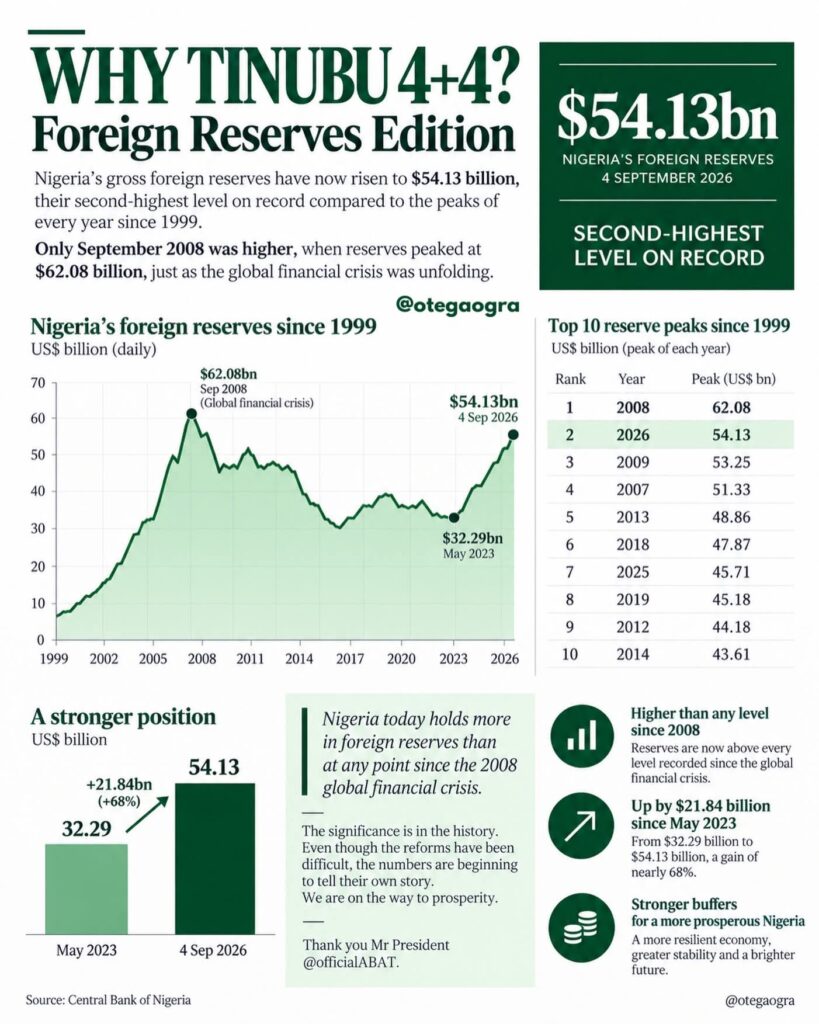
Nigeria’s gross foreign exchange reserves have risen to $54.13bn, representing an increase of $21.84bn, or nearly 68 per cent, from the $32.29bn recorded in May 2023.
The latest figure puts the country’s reserves at their second-highest level on record, according to figures attributed to the Central Bank of Nigeria (CBN).
The $54.13bn reserve position, recorded as of September 4, 2026, is surpassed only by the $62.08bn peak recorded in September 2008, at the height of the global financial crisis.
The latest development highlights the significant improvement in Nigeria’s external reserves position since President Bola Tinubu assumed office in May 2023, following a period of pressure on the country’s foreign exchange position.
A review of Nigeria’s reserve peaks since 1999 showed that the current $54.13bn level is higher than the peak recorded in 2009, when reserves stood at $53.25bn.
It is also above the 2007 peak of $51.33bn, the $48.86bn recorded in 2013, $47.87bn in 2018, $45.71bn in 2025, $45.18bn in 2019, $44.18bn in 2012 and $43.61bn in 2014.
The latest reserve position means Nigeria now holds more foreign reserves than at any point since the 2008 global financial crisis.
The increase represents a rise of $21.84bn from the $32.29bn recorded in May 2023, translating to a gain of nearly 68 per cent in just over three years.
The development comes against the backdrop of a series of economic reforms introduced by the Tinubu administration, including changes to the foreign exchange regime and efforts aimed at improving the country’s external position.
Commenting on the significance of the figures, the accompanying analysis by Otega Ogra said, “Nigeria today holds more in foreign reserves than at any point since the 2008 global financial crisis.”
Ogra, who is a senior presidential aide added, “The significance is in the history. Even though the reforms have been difficult, the numbers are beginning to tell their own story. We are on the way to prosperity.”
The reserve accumulation provides Nigeria with a larger external buffer and potentially greater capacity to withstand external economic shocks, while also strengthening confidence in the country’s ability to meet international obligations.
The figures also mark a sharp turnaround from the reserve position recorded at the beginning of the current administration.
In May 2023, Nigeria’s reserves stood at $32.29bn. By September 4, 2026, the figure had climbed to $54.13bn.
The analysis described the development as “a stronger position,” pointing to the $21.84bn increase recorded over the period.
It further described the stronger reserve position as providing “stronger buffers for a more prosperous Nigeria,” adding that it could support “a more resilient economy, greater stability and a brighter future.”
Despite the improvement, the current reserve level remains about $7.95bn below the record $62.08bn achieved in September 2008.
The latest figure, however, represents the strongest reserve position Nigeria has recorded in 18 years and places 2026 firmly among the years with the highest foreign exchange reserves in the country’s history.