


Society
One Identity, Many Services – How Tinubu’s New NIMC Law Will Change Everyday Life For Nigerians
replaces the legal framework that has guided Nigeria’s identity management system for nearly two decades


President Bola Ahmed Tinubu has signed the National Identity Management Commission (NIMC) Act 2026 into law, a move expected to deepen the role of the National Identification Number (NIN) in accessing critical services and strengthen Nigeria’s digital identity ecosystem.
The new legislation replaces the legal framework that has guided Nigeria’s identity management system for nearly two decades, introducing reforms aimed at improving service delivery, enhancing data protection, and expanding access to opportunities for millions of Nigerians.
Announcing the development, President Tinubu said the law provides Nigeria with “a modern, secure, inclusive and digital identity framework fit for the Nigeria we are building.”
According to the President, the Act positions NIMC at the centre of Nigeria’s Digital Public Infrastructure and National Public Key Infrastructure, enabling the country to build a trusted system for identity verification, secure transactions, digital signatures and other digital services.
For ordinary Nigerians, the reforms could have far-reaching implications.
The President said the National Identification Number would now serve as a stronger gateway to a wide range of services, including passport applications, voter registration, bank account opening, telecommunications services, pensions, insurance, tax payments, consumer credit and access to government programmes.
“Your National Identification Number will now serve as a stronger gateway to critical services, including passports, voter registration, bank accounts, land transactions, telecommunications, pensions, insurance, tax payments, consumer credit and government services,” Tinubu stated.
The development is expected to further consolidate the government’s efforts to create a unified identity system that reduces duplication, improves efficiency and simplifies access to public and private sector services.
The President stressed that the law was designed not only to modernise identity management but also to protect citizens’ personal information.
“The Act also strengthens the protection of citizens’ data. Personal information cannot be accessed carelessly, used outside its original purpose, or treated without regard for consent and due legal process,” he said.
He added that privacy protections contained in the legislation would ensure that citizens’ data is handled responsibly and within the bounds of the law.
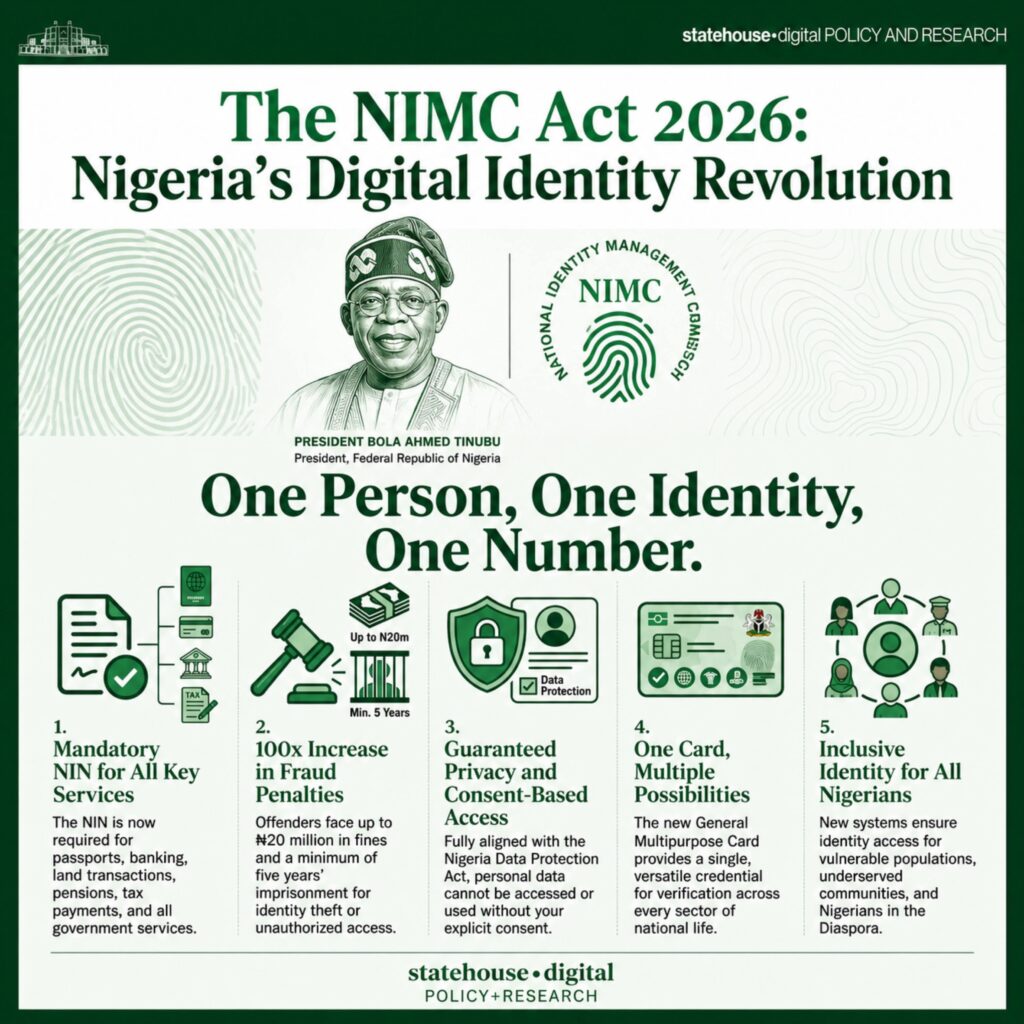
“The privacy of Nigerians must be protected, and this law makes that clear,” the President said.
Tinubu also emphasized the inclusion objectives of the new framework, noting that special attention was given to vulnerable populations, underserved communities and Nigerians living abroad.
“I gave specific instructions that this law must also protect the vulnerable, the underserved, and Nigerians in the Diaspora. No Nigerian should be locked out of opportunity because they lack a trusted identity,” he disclosed.
Beyond service delivery and inclusion, the law introduces stronger sanctions against identity-related crimes, including identity theft, multiple registration, unauthorized access and abuse of the national identity system.
The President warned that the government would not tolerate attempts to undermine the integrity of the country’s identity infrastructure.
“We will not tolerate those who forge identities, steal the identities of others, or exploit the system,” he declared.
The Act also expands representation on the NIMC Board, strengthens governance structures and introduces additional accountability measures aimed at improving the commission’s effectiveness.
Tinubu described the legislation as a landmark reform that would support the country’s broader digital transformation agenda and contribute to building a more secure, inclusive and prosperous Nigeria.
“Together, we are building a more secure, inclusive and prosperous Nigeria,” the President said, adding that the new law reflects the administration’s commitment to delivering on its Renewed Hope Agenda.
Observers say the success of the reforms will depend largely on effective implementation, wider enrollment of citizens into the national identity database and seamless integration of identity services across government agencies and private-sector institutions.