

Politics
Atiku’s Claims: Tunji-Ojo Explains Why Some Northern Borders Remain Restricted
rejecting suggestions that the restrictions amount to neglect by the Federal Government.

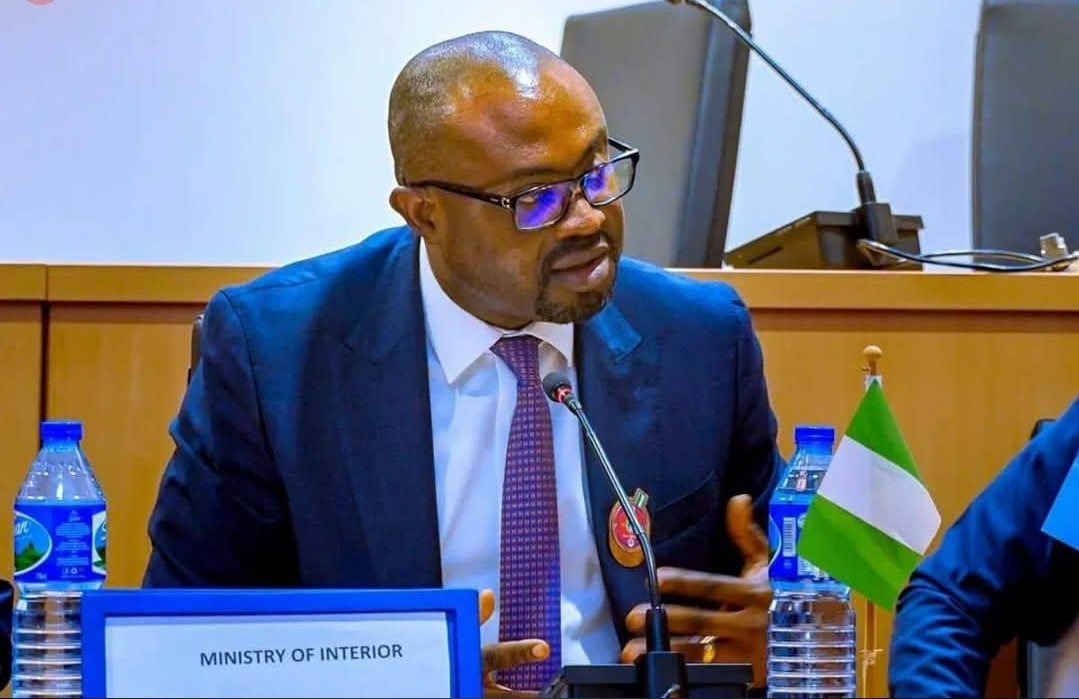
The Minister of Interior, Olubunmi Tunji-Ojo, has explained that tighter controls at some northern border crossings are deliberate security measures, rejecting suggestions that the restrictions amount to neglect by the Federal Government.
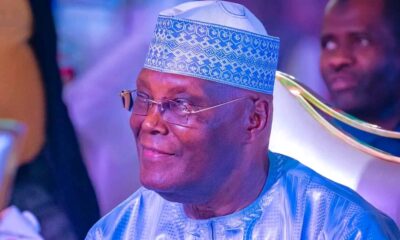
Tunji-Ojo, who supervises the Nigeria Immigration Service, said Nigeria’s borders were not closed and therefore could not be “reopened” as claimed by former Vice President Atiku Abubakar.
Atiku had spoken of plans to reopen Nigeria’s land borders if elected president in 2027, specifically mentioning Nigeria’s borders with Cameroon, Chad, Niger Republic and Benin Republic.
But in a statement on Saturday, Tunji-Ojo said the assertion did not reflect the current situation at the country’s borders.
He said several major land borders had already been reopened, citing Seme, Illela, Maigatari and Mfum, which were reopened on December 16, 2020.
According to him, Idiroko and Ikom were subsequently reopened for goods and services on April 20, 2022, while Kamba and Tsamiya in Kebbi State were reopened under the current administration in February 2026.
The minister also distinguished security-related border closures from the trade policy that affected land borders in 2019.
He said the prolonged closures at Banki and Amchidé on the Cameroon border were triggered by Boko Haram activities in 2014, rather than the 2019 trade policy.
“Not every northern crossing is fully unrestricted today,” Tunji-Ojo said, explaining that tighter controls remained necessary in areas where banditry or residual insurgent activity persisted.
He added that reopening such crossings ahead of improvements in the security situation could expose traders and border communities to greater risks.
Tunji-Ojo said the Cameroon crossings were reopened in 2019, while Fotokol and Gambaru followed in 2021 after joint military and stabilisation efforts by Nigeria, Cameroon, Niger and Chad.
He argued that presenting the different developments as one continuous border shutdown since 2019 amounted to conflating distinct issues.
“Folding this separate, security driven history into one continuous 2019 shutdown misrepresents two distinct issues, trade regulation and counter insurgency, as a single failure,” he said.
The minister said modern border management could not be reduced to a choice between completely shutting borders and allowing unrestricted movement.
“Modern border management is not a choice between total closure and unrestricted movement; it requires security, documentation, customs compliance and controlled trade facilitation together,” he disclosed.
Tunji-Ojo urged political actors to focus on presenting clear policy alternatives rather than rewriting the recent history of Nigeria’s border management.
“If he has a new border proposal, he should set it out and explain how it differs from the current approach, rather than treating separate trade, security and infrastructure issues as one and the same,” the Minister advised.