

Society
Customs Advocates Intelligence-Led Border Security To Tackle Arms Smuggling
curb the proliferation of illicit small arms and light weapons across Nigeria’s borders.


The Nigeria Customs Service (NCS) on Wednesday, 29 July 2026, called for intelligence-led border security, stronger inter-agency collaboration and the deployment of modern surveillance technology to curb the proliferation of illicit small arms and light weapons across Nigeria’s borders.
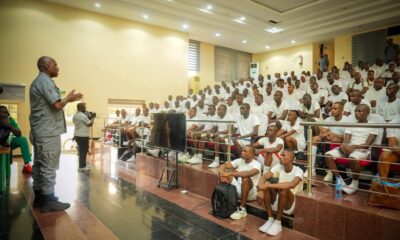
The Service made the call at the Leadership Course on the Control of Small Arms and Light Weapons (SALW), organised by the Defence Intelligence College, Abuja, where the Comptroller-General of Customs, Adewale Adeniyi, was represented by the Deputy Commandant and Director of Studies, Nigeria Customs Command and Staff College, Gwagwalada, Comptroller of Customs Haniel Hadison.
Delivering a lecture titled, “The Role of the Nigeria Customs Service in Intercepting Arms Smugglers and the Challenges of Border Management,” Comptroller Hadison said the Service had remained at the forefront of national efforts to disrupt illicit arms trafficking through intelligence-led enforcement, strategic interceptions and collaboration with relevant security agencies.
He maintained that, “Effective border security cannot be achieved by the Nigeria Customs Service alone. It requires sustained cooperation among all relevant stakeholders, strengthened intelligence sharing, active engagement with border communities and closer collaboration with neighbouring countries.”
Comptroller Hadison identified porous land and maritime borders, numerous illegal crossing routes, inadequate surveillance technology, shortage of trained personnel, insufficient operational logistics and increasingly sophisticated concealment methods employed by smugglers as major challenges confronting effective border management, adding that, “Government should continue investing in modern border surveillance systems, non-intrusive inspection technology, drones, biometric border management and officers’ capacity development to improve operational effectiveness.”
He further stated that intelligence gathering, risk profiling and continuous professional training remain critical to combating emerging smuggling techniques and transnational organised crime, disclosing that, “The Nigeria Customs Service has consistently demonstrated that intelligence-driven border management, inter-agency collaboration and professional enforcement can significantly disrupt illicit arms trafficking into Nigeria.”
According to him, successful interceptions recorded by the Service at seaports and airports have demonstrated the importance of modern inspection technology, intelligence gathering, effective risk profiling and strategic collaboration with other security agencies in preventing illegal arms from entering the country.
He noted that the Service’s operational successes provide practical lessons for strengthening border security, emphasising that a coordinated national border management strategy, backed by adequate funding, institutional reforms and stronger sanctions against arms traffickers, would significantly reduce illicit arms smuggling and enhance Nigeria’s security.