

Society
Things I Talked About Nigeria At G77+China Leaders’ Summit – Shettima
Our scientists have successfully positioned our nation as a prominent global hub

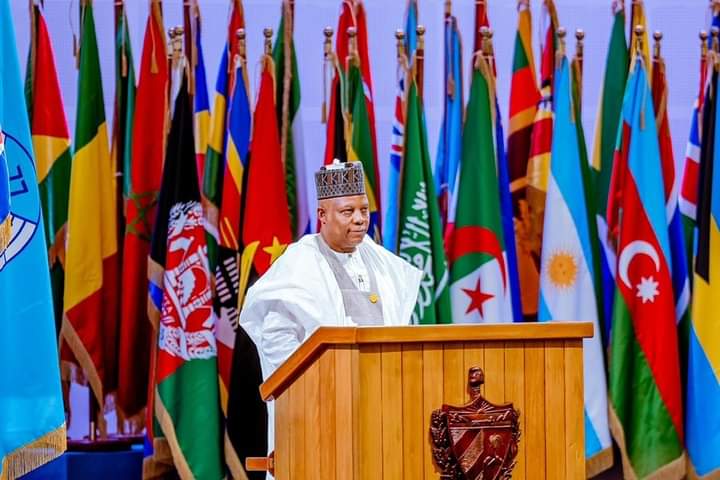
Vice President Kashim Shettima spoke to world leaders at the G77+China Leaders’ Summit on Friday.
Shettima who represented President Bola Tinubu at the summit highlights the things he discussed in a post that reads….
On Friday, I addressed World leaders at the ongoing G77+China Leaders’ Summit at the Palace Convention Havana, Cuba.
Speaking to an assembly of Heads of State and Government, the UN Secretary-General, Antonio Gutteres and delegates from over 100 countries from the global South, I emphasized on the need to be focussed on leveraging cooperation or partnership for finding realistic solutions to global challenges.
We must always remember that cooperation is our compass and the most realistic path towards maximizing the opportunities and resolving challenges before us.
We must not allow geopolitical tensions in any corner of the world to deter us from forging a collective and mutually advantageous path forward – a roadmap of shared prosperity and progress, he advised.
I expressed Nigeria’s commitment to tow the path of partnership with member-States of the G77+China towards addressing global challenges.
We shall champion initiatives that harness the potential of science, technology, and innovation to confront economic challenges, particularly within the global south.
Speaking on the theme: “Current Development Challenges: The Role of Science, Technology and Innovation” I underscored the prominent role which science, technology and innovation have always played in resolving challenges from the past to the present.
I delivered a speech titled: “From Pandemic to Paradigm Shift: Nigeria’s Road to Reinvention” I recalled that throughout history, science and technology have shaped the course of nations. The phases of the Industrial Revolution, from the first to the fourth, and from mechanization to automation, have determined the prosperity of those nations.
It is crucial to acknowledge that the developing world found itself at a disadvantage in the earliest phases of these transformations, struggling to compete fairly as these revolutions swept across the globe.
Nigeria is contributing its own share in leveraging science, technology and innovation to resolving challenges such as Covid-19 and the climate crisis.
Nigeria understand that the key to advancing innovation in science and technology lies in fostering a vibrant knowledge economy and facilitating the unrestricted exchange of ideas.
Across the globe, one would be hard-pressed to identify a premier institution, even within the most developed nations, where a Nigerian, trained at home, is not contributing significantly, whether as a tech innovator or a medical specialist, in the noble pursuit of improving the human condition.
The COVID-19 pandemic, while a tragic chapter, served as a catalyst for our brilliant minds in Nigeria to rejuvenate their pursuits in the fields of science and technology.
Our scientists have successfully positioned our nation as a prominent global hub for mRNA vaccine production, a milestone currently in progress.
Nigeria’s demographic advantage is not limited to the absence of an aging population. Nigeria stands as a beacon of youthful talent and innovation.
These young citizens are not only dedicated to integrating human elements into the evolving technological sphere, but their efforts also extend to diverse fields, ranging from telemedicine to the automation of agriculture, all with the aim of making our daily lives more seamless.
It is my opinion that the climate crisis around the globe too has dominated our agenda, prompting our youthful innovators to engage in crafting solutions.
This fervent commitment has resulted in the establishment of start-ups like the Climate Action Africa (CMA) Labs, a hub dedicated to addressing diverse challenges posed by climate change, including severe droughts, flooding, and the escalating agricultural complexities.
The stakes are high. If we fail to act now, the prevailing trend could imperil our attainment of the Sustainable Development Goals (SDGs).