

Society
ICPC Boss Warns Against Producing Brilliant Lawyers Without Character
stressing that legal education must produce lawyers of integrity and not merely legal experts.

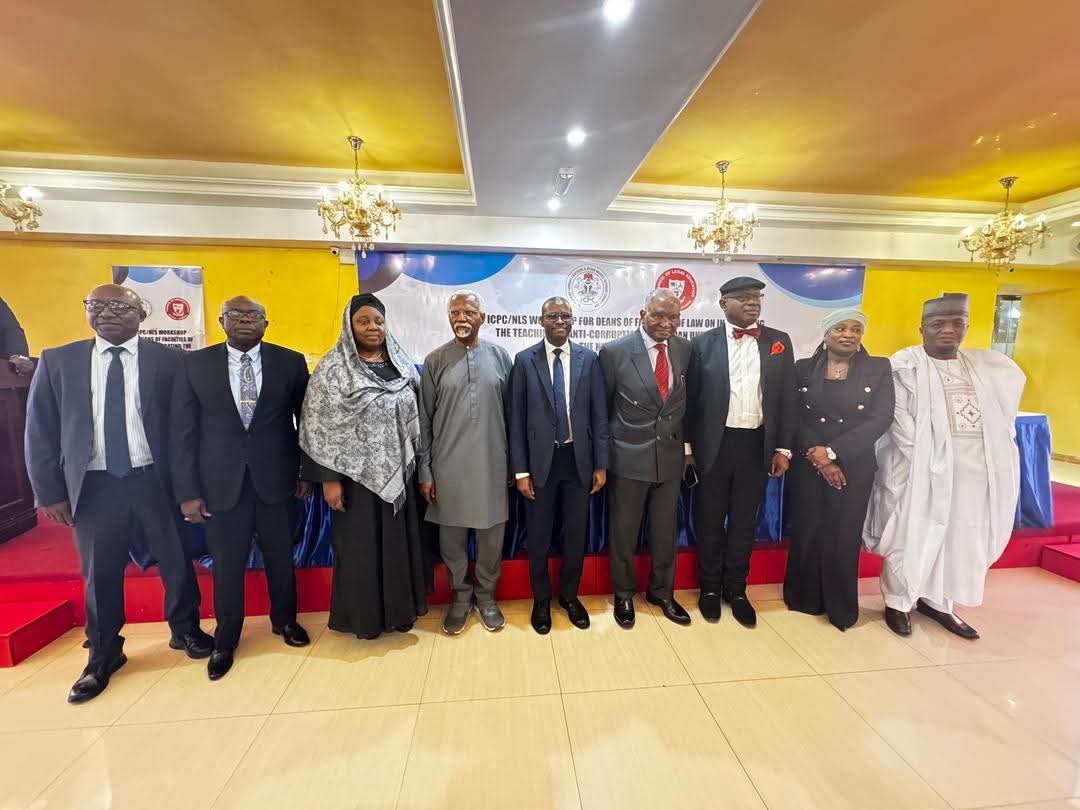
The Chairman of the Independent Corrupt Practices and Other Related Offences Commission (ICPC), Dr. Musa Adamu Aliyu, SAN, has called for the institutionalisation of anti-corruption education in Nigeria’s legal training system, stressing that legal education must produce lawyers of integrity and not merely legal experts.
Dr. Aliyu made the call on Tuesday in Abuja while delivering a welcome address at the ICPC/Nigerian Law School Workshop for Deans of Faculties of Law on the Teaching of Anti-Corruption in Nigerian Universities and the Nigerian Law School.
The workshop, themed “Institutionalising Anti-Corruption Education in Nigeria Legal Training,” brought together stakeholders in legal education to deliberate on integrating anti-corruption studies into legal training.
According to the ICPC Chairman, corruption continues to undermine Nigeria’s development by weakening public institutions, eroding public trust, distorting economic growth, and compromising effective service delivery.
He noted that addressing the menace requires not only investigation and prosecution but also preventive, educational, and value-driven approaches that can shape ethical consciousness and promote accountability.
Speaking on the role of the legal profession in nation building, Dr. Aliyu said, “The legal profession occupies a central position in the administration of justice and the sustenance of the rule of law. Lawyers serve as custodians of the law, defenders of justice, and critical actors within the justice system.”
He further stressed the need to instil ethical values early in legal training, stating that, “Embedding these principles within university legal education and professional training at the Nigerian Law School is essential to producing lawyers who are not only intellectually competent but also ethically grounded and committed to national development.”
Dr. Aliyu explained that the workshop aligns with the Commission’s preventive and public education mandate as provided under the Corrupt Practices and Other Related Offences Act, 2000.
He said the engagement was designed to provide a platform for brainstorming on the integration of anti-corruption studies into the LL.B curriculum in line with the Core Curriculum and Minimum Academic Standards (CCMAS), while also examining curriculum content, delivery models, and lecturer training methodologies.
The ICPC Chairman further clarified that the Commission was not seeking to impose a rigid framework on universities or the Nigerian Law School, but rather was intended to encourage collaboration and allow stakeholders in legal education to collectively determine the most effective approach for integrating anti-corruption education into legal training in Nigeria.
The Hon Minister of Justice & Attorney General of the Federation, Prince Lateef O. Fagbemi, SAN, in his opening remarks, challenged Deans of Faculties of Law and legal scholars to play a more active role in confronting corruption and restoring ethical values in Nigerian society.
The Minister, represented by the former Attorney General of the Federation, Mr. Kanu Agabi SAN, described corruption as one of the major factors responsible for Nigeria’s institutional and developmental setbacks, noting that educators must continue to uphold moral standards despite the persistence of corruption across different sectors of society.
He called for reforms in Nigeria’s educational system, stressing the importance of a curriculum that promotes civic responsibility, practical knowledge, national history, and community values.
He urged Nigerian academics to take greater ownership of the country’s historical narrative and intellectual development.
He further called for national unity and cautioned against divisions along ethnic, religious, political, and social lines, stressing the need to preserve Nigeria’s collective identity and strengthen public institutions through ethical leadership and responsible citizenship.
The Chairman of the Council of Legal Education, Chief Emeka Ngige, SAN, OFR, described the workshop as timely and necessary in confronting the challenge of corruption in Nigeria.
He commended the ICPC for convening the engagement and emphasized the need for actionable reforms capable of strengthening integrity within the legal profession.
Chief Ngige stated that the Nigerian Law School has continued to integrate ethical content across its modules, especially through Professional Ethics and Skills, with the broader objective of instilling character, integrity, and accountability in aspiring lawyers.
According to him, “Infusing the anti-corruption studies into the curriculum of the Law School is an idea whose time has come,” adding that such a move would help nurture future legal practitioners with the moral rectitude required to support anti-corruption efforts and restore public confidence in the justice system.
He urged stakeholders to develop practical and impactful recommendations capable of strengthening anti-corruption education in legal training institutions.
Also speaking at the workshop, the Executive Secretary of the National Universities Commission (NUC), Professor Abdullahi Yusuf Ribadu, represented by Mr. L.M Farouk, described universities as critical institutions for shaping ethical values and responsible citizenship.
According to him, “University education goes beyond acquiring certificates and professional knowledge. It is also about shaping the character and civic responsibilities of students and all members of the University community.”
He emphasized that legal education carries a greater responsibility because of the profession’s role in upholding justice and the rule of law.
The event also featured paper presentations by Prof. Muhammad Tabiu, SAN, Prof. Joy Ezeilo, SAN, and Prof. Adedeji Adekunle, SAN.