


Society
ICPC Chairman Champions New Ways To Fight Corruption
“we cannot fight 21st century corruption with 20th century tools.”

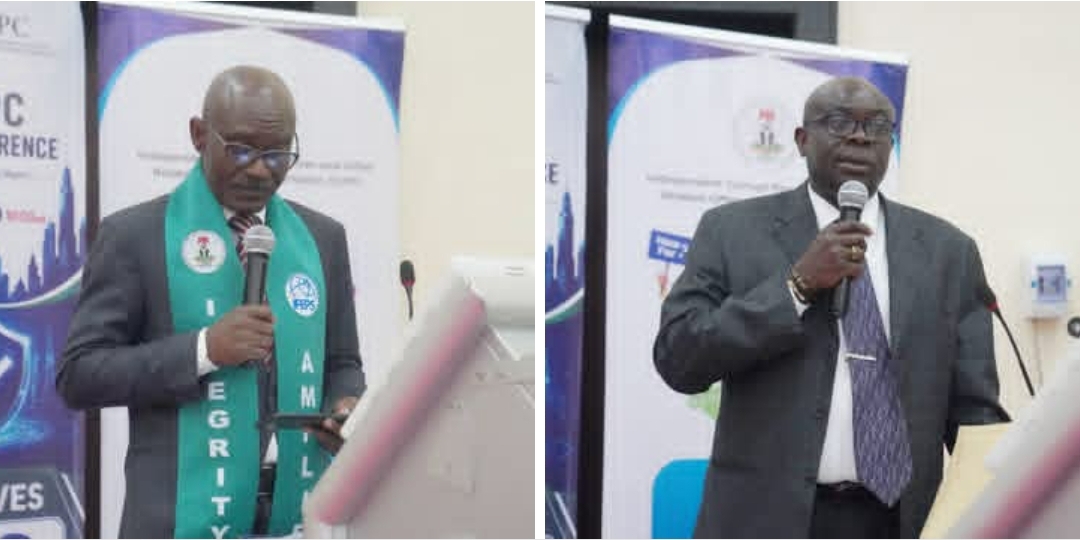
The Chairman of the Independent Corrupt Practices and Other Related Offences Commission (ICPC), Dr. Musa Adamu Aliyu, SAN, has called for innovative and technology-driven approaches to tackling corruption, stressing that “we cannot fight 21st century corruption with 20th century tools.”
He made the statement at the IFEPS/ICPC Stakeholders Conference held at the Commission’s Headquarters in Abuja.
The conference, themed “Securing Tomorrow: Ethics at the Frontier of Innovation,” brought together leaders, policymakers, educators, civil society organisations and private sector stakeholders to advance ethics, transparency and accountability as essential pillars for Nigeria’s development.
Declaring the conference open through the Secretary to the Commission, Mr. Clifford Okwudili Oparaodu, DSSRS, the ICPC Chairman said corruption has become increasingly digital, faster and more sophisticated, making it imperative for anti-corruption strategies and ethical standards to evolve accordingly. “Our theme, Securing Tomorrow: Ethics at the Frontier of Innovation, speaks directly to the challenge before us. Corruption is evolving. It is now digital, faster and more sophisticated. If our ethics do not evolve with it, we will be left behind. That is why this conference is critical.
We cannot fight 21st century corruption with 20th century tools,” he stated.
Dr. Aliyu outlined three key priorities for strengthening integrity in Nigeria. The first is Prevention through Values through the C-H-I-L-D-R-E-N Values Initiative, aimed at instilling honesty, discipline and respect in children from an early age.
The second is Responsibility in the Digital Space through the Citizens Digital Responsibility Initiative (CDRI), which promotes ethical online behaviour and combats cybercrime, misinformation and digital fraud.
The third is Sustainability through Funding through the newly launched Ethics Endowment Fund (EEF), designed to provide sustainable resources for ethics education, public sensitization and the institutionalisation of integrity nationwide.
Reaffirming the Commission’s commitment to combating corruption, Dr. Aliyu stated that while enforcement remains a core mandate of the ICPC, prosecution alone cannot eradicate corruption.
He stressed the need to build a national culture where integrity becomes the accepted standard of behaviour, adding that the Commission has already laid important foundations through initiatives such as the National Values Curriculum (NVC), the National Ethics and Integrity Policy (NEIP), and the Sexual Harassment Policy.
Earlier, in her welcome address, the Executive Director of the Institute for Ethics and Professional Studies (IFEPS), Dr. (Mrs.) Uyim Akpabio, said the conference was convened at a time when technology is advancing faster than regulations, making it imperative to embed ethics into innovation.
She observed that while artificial intelligence, data and digital platforms are reshaping governance and society, integrity must remain the guiding principle. She commended the ICPC for facilitating the National Values Curriculum (NVC) and the National Ethics and Integrity Policy (NEIP), describing them as complementary frameworks for nurturing ethical values in young people and promoting integrity in public and private institutions.
Dr. Akpabio explained that the conference was built around three key objectives—Alignment, Action and Activation.
According to her, the initiative seeks to unite government, academia, the private sector, civil society, faith-based organisations, the media and families in promoting ethics as a shared national responsibility.
She urged participants, particularly children and youths, to become champions of the C-H-I-L-D-R-E-N Values Initiative, the Citizens Digital Responsibility Initiative (CDRI), the National Values Curriculum and the National Ethics and Integrity Policy in their schools, workplaces and communities, while commending the ICPC for its unwavering leadership in institutionalising ethics in governance.
In her opening remarks, the Chairperson of the Board of the Institute for Ethics and Professional Studies (IFEPS), Prof. Ekanem Braide, represented by Amb. (Mrs.) Anthonia Ekpa, said the Institute, in collaboration with the ICPC, streamlined the originally planned two-day stakeholders’ conference into a one-day event to ensure greater participation, focus and impact while maintaining the quality of engagement and expected outcomes.
She noted that the conference theme underscores the urgent need to align rapid technological advancement with ethical values, warning that innovation without integrity could fuel inequality, misinformation and the erosion of public trust. She added that the conference would also witness the joint launch of three flagship initiatives by IFEPS and ICPC aimed at institutionalising ethics, integrity and responsible digital citizenship, stressing that securing the ethical values of young people is fundamental to securing Nigeria’s future.
Delivering the goodwill message on behalf of the Corps Marshal of the Federal Road Safety Corps (FRSC), Shehu Mohammed, mni, Assistant Corps Commander Agboola Olundegun commended the organisers for choosing a theme that reflects the realities of an era in which technology is rapidly transforming governance and public service delivery.
He emphasized that innovation must be guided by integrity, transparency, accountability and professionalism if it is to strengthen governance and earn public trust.
He noted that the FRSC has continued to leverage technology through digital driver’s licence and number plate administration, electronic traffic enforcement, real-time patrol monitoring and crash data management systems to improve service delivery. He, however, maintained that technology alone cannot eliminate corruption or guarantee excellence, stressing that ethical values remain indispensable to sustainable national development.
Also delivering a goodwill message on behalf of the Director-General of the Bureau of Public Procurement (BPP), Dr. Adebowale Adedokun, the Director of the Civil Infrastructure Department, Mr. Nasir M. Bello, described the conference as timely, noting that ethics, transparency and accountability must underpin innovation and digital transformation in public service.
He said collaboration among government institutions, the private sector and civil society is critical to entrenching integrity in governance.
Mr. Bello reaffirmed the Bureau’s commitment to promoting due process, transparency and accountability in public procurement, expressing confidence that the conference would foster stronger partnerships and practical strategies for advancing ethical leadership and strengthening Nigeria’s anti-corruption efforts



